
Last updated on March 12th, 2024 at 01:41 am
Last updated by Maredith Damasco
Every disc golfer, regardless of experience, understands that a driver is crucial for maximum distance. However, it’s important to note that achieving optimal distance requires more than just tossing the disc and hoping for the best.
But how to throw a disc golf driver the right way? The key is to gather as much information as possible to throw a disc golf driver properly. After all, it is all about the techniques you use and the other factors that will help the driver fly to a longer distance on the course. This article will teach different tips and guidelines in throwing a disc golf driver the right way.
Throwing a Disc Golf Driver the Right Way
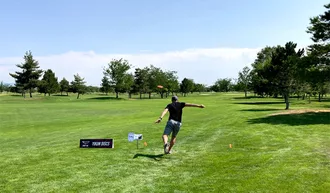
When it comes to throwing a disc golf driver, the primary objective is to throw it straight and far. And this can be done by knowing the proper technique on how to do it. You will need to know the excellent grip and the right disc to achieve the purpose. When looking for your shot, you focus on different factors such as the wind, the slopeness of the ground, and the other obstacles on the course.
My advice is to through the disc using the backhand throw to have the chance to cover maximum distance. Throwing with your entire body will allow you to throw further and provide more consistency on the throw. Familiarizing this forehand throw is a significant first step, but incorporate the proper throwing technique to achieve greater distance and a straight line.
How to Throw a Disc Golf Driver Far
For maximum disc golf driver distance, it begins with your grip. I prefer the power grip with four fingers under and the thumb on top of the flight plate. Maintain a firm grip with balanced thumb pressure, neither too far on the end nor too close to the edge.
When it comes to the form and the throwing technique, start learning the basics and take it from there. In the tee pad, you want to back up and square your body to the target. Ensure a straight line to your target. I prefer starting from the back right corner of the tee pad for a four-step run-up and a smooth release.
Start by taking one medium step to your left and then another medium step to the right. At this point, you will need to try to turn your lower body and load your legs. Load your hips by crossing the left leg behind, taking a big step to the right, shifting your body weight, turning your torso, and driving the disc forward for the release.
You will need to work on the four-step run-up and get comfortable when doing it. Doing the runup properly will let you drive your body correctly to get your momentum forward while releasing the disc out of your hand. It can be complicated at first but keep working on getting your driver at a maximum distance.
How to Throw a Disc Golf Driver Straight
To throw a disc golf driver straight, pull it in a straight line with a strong follow-through. A linear motion increases the chance of a straight flight. Two methods to achieve this are releasing a stable disc flat or an understable disc with a hyzer angle.
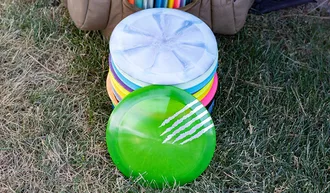
The first technique is to use a stable disc or a straight disc and throw it flat in the air. In looking for a disc, choose something that has a turn rating from 0 to -1. If you are not familiar with the flight rating of the disc, it is found on the surface of the disc, and the turn rating is the third from the top. You can also try an overstable disc because this disc can also fly in a straight line when released flat.
Another method to throw a disc golf driver straight is to release it at a hyzer angle. But you will need to use an understandable disc in doing so to achieve a straight line. Again, you will need to check on the flight rating system and look for a -2 or even lower turn rating to achieve maximum performance.
For a flat release, apply maximum force to the disc and focus on pulling your arm for a powerful snap during release. While it may be frustrating initially with some failures, persevere in refining your throw. When attempting a hyzer flip, ensure a low release and a hyzer angle followed by a straight trajectory.
Conclusion
Improve your disc golf throwing distance by mastering the proper driver technique, focusing on throwing straight for maximum distance, alongside familiarity with putters and midranges. Improving your game and achieving your maximum throwing distance involves incorporating various methods and techniques.
