If I had to pick the most useful disc golf accessory, a retriever would be near the top of the list, if not number one. I’ve personally used a retriever many dozens of times to get a disc out of some water, from over a fence, or out of a tree. You only have to rescue a couple discs for the retriever to pay for itself.
I’ve tried many different retrievers, including different types. In this blog I’ll give you a detailed explanation about the different retrievers, and the pros and cons of each. That will help you find the best product for your needs. We’ll start by grouping retrievers into two categories: Extension and rope-assisted retrievers.
Rope-Assisted Retrievers
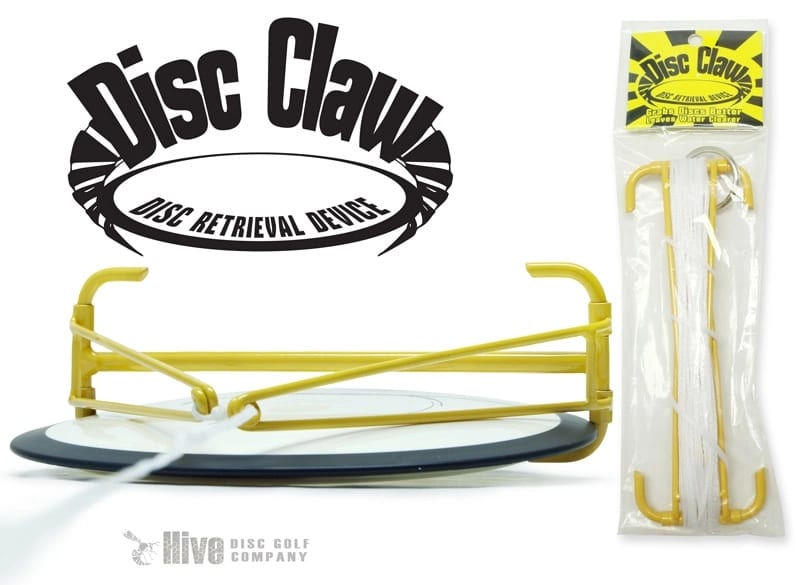
These devices work by throwing the retriever part into the water, then pulling the attached rope to drag the retriever across the bottom, and hopefully snag the disc along the way. It helps if you can see the disc, but tossing the retriever in random places might get you a disc or two.
Advantages: By adding additional rope to the end of the existing rope, you can extend the reach of the retriever to well past where extendable retrievers can reach. It is compact and stores easily in a bag or cart.
Disadvantages: This type of retriever is pretty much only useful in water and maybe over a fence. If you have a disc stuck in a tree, this type won’t work. It can also be tricky to use in the river if the water is flowing very fast.
Pro Tip: These retrievers come with the rope wrapped around the metal part of the retriever. The idea is that you can unwrap it, get your disc, then wrap it back around the metal part. I recommend getting a spool to wrap the rope around. It’s a little bigger to carry, but you don’t have to unwrap the entire rope to use it. You simply unwind the length you need, then wind it back when you’re done!
Examples:

Extension Retrievers
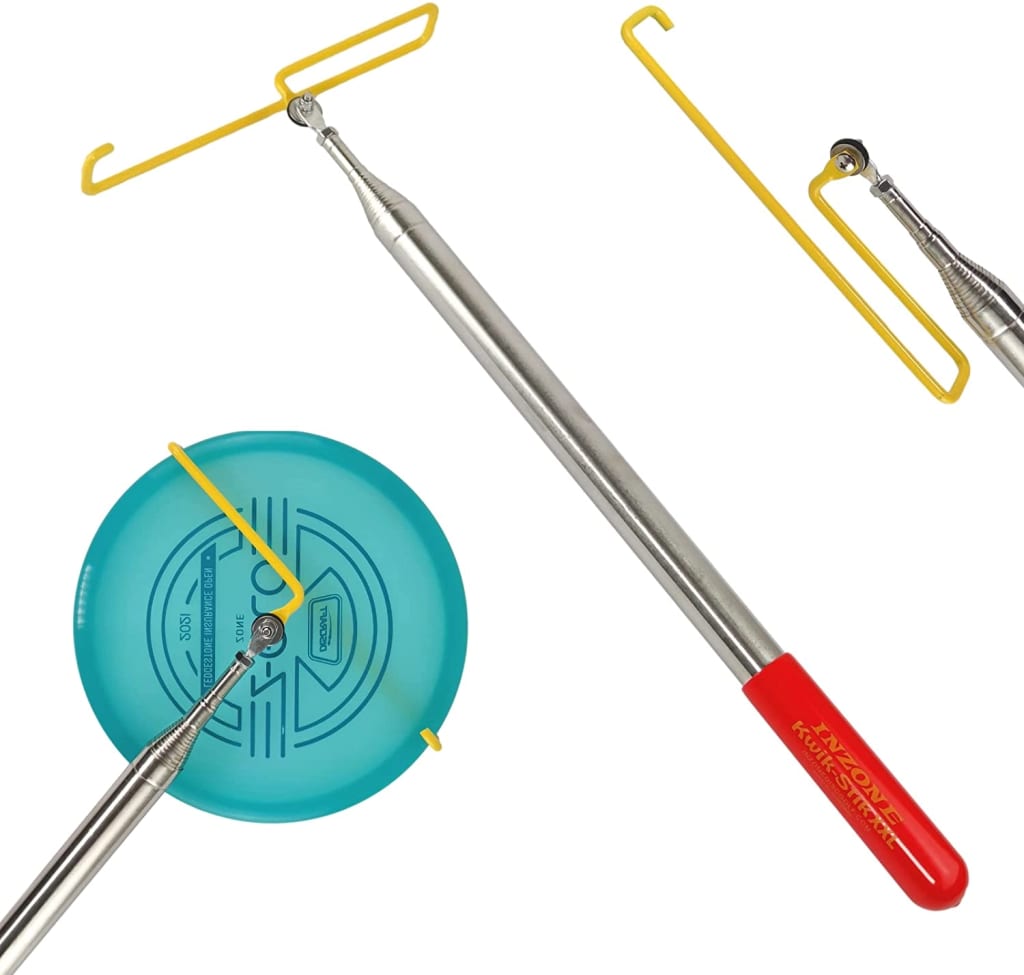
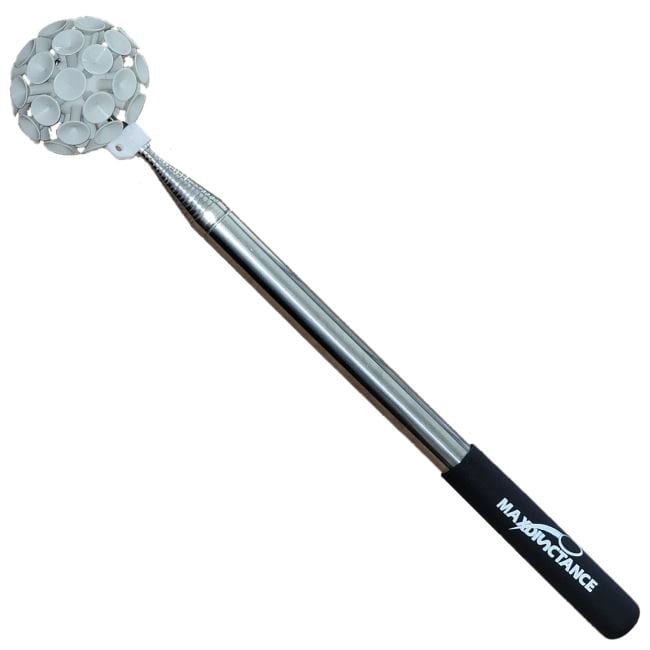
This popular type of disc golf retriever extends up to 30 feet, then collapses back down to a relatively small size after use. With that extended distance, you can reach into a pond, river, tree, over a fence, or in some bushes. They have a variety of tip options, from sticky ball to hooks, to tips that ‘surround’ the disc and hold it while you pull it back to you. (Not all tips fit all retrievers. Check sizing before you order a different tip.)
Advantages: The versatility of this type of retrievers means that you can use it in a variety of disc-retrieval situations. It is also fairly easy to carry and use. River retrievals can be tricky, but can also be successful. If the water isn’t moving very fast, you have a great chance of getting your disc back. The sticky-ball tips are great for use in water.
Disadvantages: You are limited by the size of the retriever. If the disc is too far out in the water, or too high in the tree, you won’t be able to use the retriever. Sticky-ball tips don’t always hold the disc and you might just dislodge it and it can drift downriver. Same with the hook tips. The sticky ball looses it stickiness if it gets dirty (It can be cleaned with water). It can also be useless in some thick trees, where a hook might shine. If you are going to carry different tips, you might need to carry a small wrench to swap them out.
Pro Tip: If you don’t need the full length of the retriever, start to extend the pole from the handle segments instead of pulling the tip-end segments out first. Then you end up with thicker sections extended and a more rigid retriever. (That is only the case if you don’t need the pole fully extended.)
Examples:

So, Which Type Should You Get?
Consider where you play and in what conditions you might need a retriever. Most conditions favor an extendable retriever. However, if you have several ponds where you play, you might want to think about the rope-assisted retrievers.
I have both, but I rarely carry the Golden Retriever. I just keep it in the car so I can attempt to get a lost disc after the round. I typically carry an extendable retriever during most rounds, since it can be used in nearly every situation.
The ‘Winner’?
I would definitely recommend an extendable retriever if you are only going to get one type. They can be used for discs that end up in water, in trees or bushes, and over fences. They take up a little more room than rope types, but their usefulness outweighs the extra space.
Extendable retrievers come in a variety of lengths. I would say get the longest one you can afford, if you are willing to haul around a bigger retriever. Having said that, I carry a 16-footer and find it able to reach 90% of my discs. I have the sticky-ball tip as my go-to tip. There are water hazards on several local courses, but the most common retrieval is from trees.
If you can afford both types, it is nice to know you give your wayward disc the best chance for recovery.
A Few Other Retriever Options
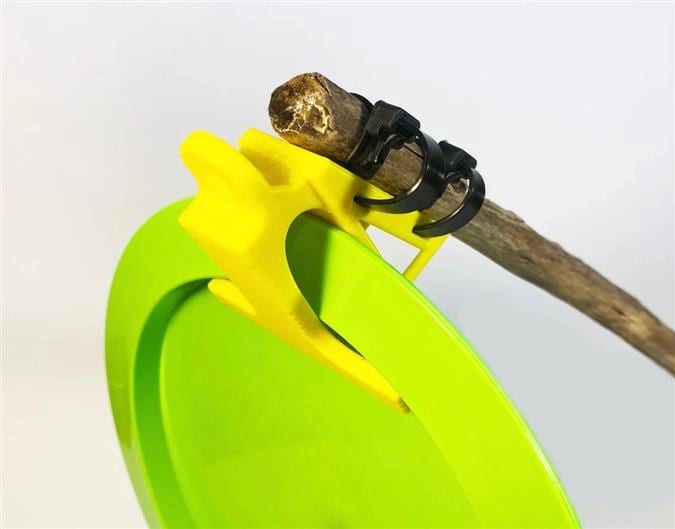
Discreettiever – You can stash this small retriever in your bag and when you need to retrieve a disc, simply attach the device to a stick with the attached removable zip ties.
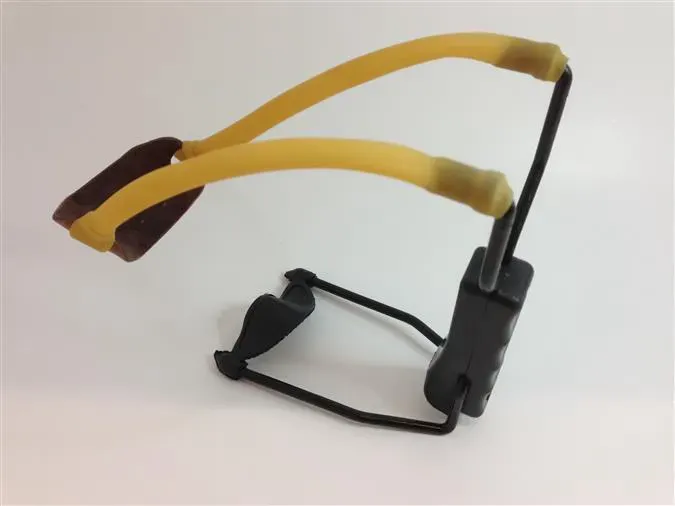
Wrist Rocket – If a disc is in a tree and beyond the reach of an extendable retriever, a wrist rocket is a possible way to get it down. You can look for rocks to use as ammo, or carry biodegradable clay balls.